If you’re thinking about straightening your teeth, you’ve probably landed on the same question most people do: Invisalign or braces? Both are proven options. Both can give you great results. But they work differently, feel differently, and fit different lifestyles. The right choice depends a lot more on your specific situation than most comparison articles will tell you.
Here’s an honest look at how they stack up across the things that matter most: effectiveness, comfort, cost, and day-to-day experience.
How they work
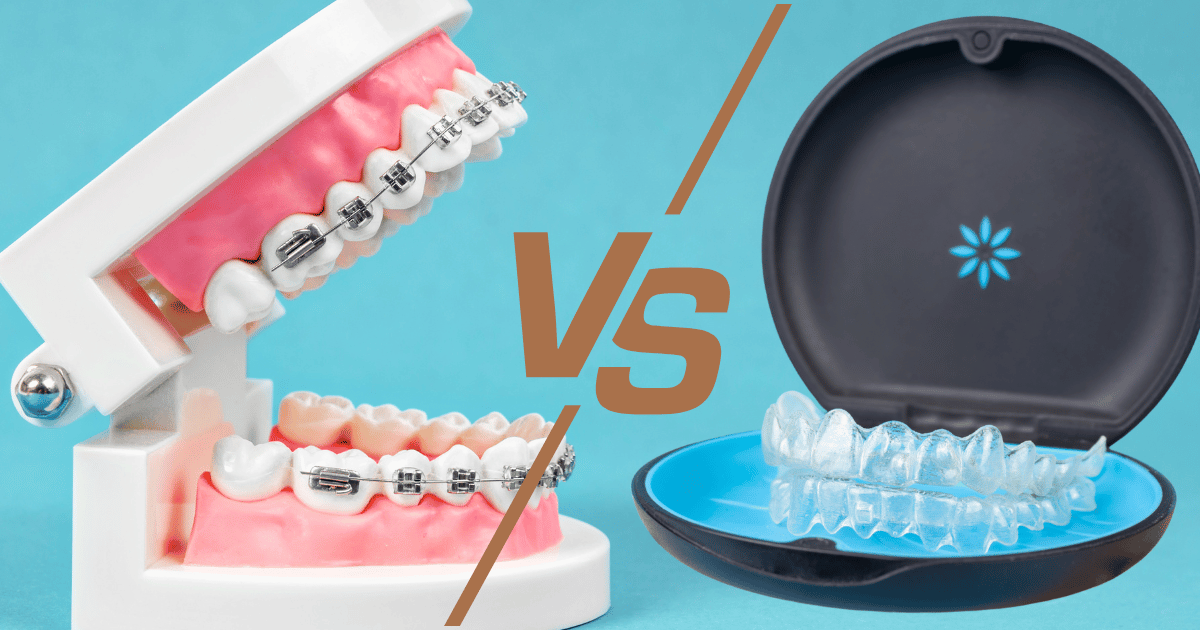
Traditional braces use metal brackets bonded to your teeth, connected by wires that get adjusted periodically to move your teeth over time. They’re fixed in place for the full duration of treatment, which typically runs anywhere from eighteen months to three years depending on the complexity of your case.
Invisalign uses a series of custom clear aligners made from smooth plastic. You wear each set for about one to two weeks before moving to the next set in the series. They’re removable, which means you take them out to eat, drink, and brush (or snap a selfie). Treatment length varies, but most straightforward cases wrap up somewhere between six and eighteen months.
What they can treat
This is where people often have outdated information. Braces have historically been the go-to for more complex cases: severe crowding, significant bite issues, or situations that require very precise multi-directional tooth movement. That reputation was earned.
But Invisalign has come a long way. It now handles a much wider range of cases than it did even five years ago, including overbites, underbites, crossbites, gaps, and moderate to significant crowding. For mild to moderate alignment concerns, clinical results are genuinely comparable to braces.
Very complex cases may still be better suited to traditional orthodontic treatment. The only way to know where your teeth fall is to have someone look at them. That’s exactly what a consultation is for.
Appearance
Invisalign aligners are clear and sit flush against your teeth. Most people won’t notice you’re wearing them. For adults who’d rather not announce they’re in treatment, that matters. For teens who are surrounded by peers doing the same thing, it may matter less.
Braces are visible. That’s not inherently a problem. Plenty of people wear them confidently. But it’s worth factoring into your decision, especially if you’re in a profession where you’re client-facing or speaking publicly on a regular basis.
Comfort and daily experience
Neither option is entirely without sensation. With braces, the brackets and wires can irritate the inside of your cheeks, particularly in the early weeks and after each adjustment appointment. Some foods become off-limits for the whole duration of treatment. Anything hard, sticky, or chewy can damage the brackets or wires. Popcorn, caramels, corn on the cob, chewing gum: all gone until the braces come off.
With Invisalign, you’ll feel some pressure when you switch to a new set of aligners. It usually settles within a couple of days. Otherwise, the aligners are smooth and comfortable, and because you remove them to eat, there are no food restrictions at all. Your diet stays exactly the same.
One honest trade-off: Invisalign requires consistency. The aligners need to be in your mouth around 20 to 22 hours a day. If they spend more time on the counter than on your teeth, the treatment won’t move the way it’s supposed to. For people who are motivated and follow through, this isn’t a problem. It’s worth being honest with yourself about it before you choose.
Cost: what to expect
This is the question most people want answered, and the honest answer is: it depends on your case.
Orthodontic treatment in Alberta is priced based on complexity and duration rather than a flat rate, so costs vary meaningfully from one person to the next. That said, for straightforward cases, Invisalign and traditional braces tend to land in a comparable range, somewhere in the ballpark of $4,000 to $8,000 for most patients, though more complex cases can run higher.
When you come in for a consultation, we’ll give you a clear breakdown of what treatment would look like for your specific situation before you commit to anything.
A few things worth knowing on the cost side:
Many dental insurance plans include orthodontic coverage regardless of whether you choose Invisalign or braces. Check your plan before assuming it’s fully out of pocket.
Financing is available through third-party providers like Lendcare to spread the cost into manageable monthly payments.
The cost of ongoing orthodontic adjustments (roughly $100 per appointment with braces) can add up over a longer treatment timeline. Invisalign includes all your aligners in the treatment fee.
What about for kids and teens?
Both options work for younger patients. Braces are often recommended for children still in active growth phases, particularly for more complex bite corrections. For teens who are mature enough to manage the wear-time responsibility, Invisalign is a well-established option and tends to be popular for exactly the reasons you’d expect: less visible, no food restrictions, easier to keep clean.
If your child needs orthodontic treatment, a consultation will help you understand which option is clinically appropriate and what your family’s priorities make most sense.
So which one should you choose?
For complex cases, braces may still be the stronger clinical choice. For most adults and teens with mild to moderate alignment concerns, Invisalign delivers results that are just as good, with a noticeably easier day-to-day experience.
But the best answer is one based on your actual teeth, not a general comparison. We use a 3D iTero scanner to show you a preview of what your smile could look like after treatment, before you commit to anything. It takes the guesswork out of the conversation and tends to make the decision feel a lot clearer.
No referrals needed. No trip to Grande Prairie. Just a straightforward conversation about what’s possible for your smile, right here in Beaverlodge.
Ready to figure out which option is right for you? Book a consultation at Dentistry on 43. Call (780) 500-1001, text us, or book online and we’ll show you what’s possible.